
25 August 2026
Connections Reform Phase 1: progress in numbers
Connections Reform is an industry-wide led programme led by the National Energy System Operator (NESO). The aim of is to accelerate the connection of generation, storage and demand projects while reducing the number of speculative projects occupying capacity in the queue.
We’re responsible for assessing, developing and delivering transmission solutions to support Connections Reform. Working closely with NESO, Ofgem and other network companies, NGET is reviewing connection applications, producing connection offers and ensuring customers have the information they need throughout the transition.
Phase1 delivery of Connections Reform focuses on customers seeking to connect by 2030 and involves issuing Gate 2 offers to eligible projects that meet NESO’s readiness and strategic alignment criteria. We’re currently progressing offer production, undertaking engineering assessments, engaging with customers and supporting the industry-wide delivery programme to ensure offers are issued efficiently and consistently.
To support transparency, we’re publishing key delivery metrics monthly, providing customers and stakeholders with visibility of progress across the portfolio, including the number of projects reviewed, offer in production, offers sent to NESO.
Further metrics shared by industry are available here: Connections Reform | National Energy System Operator and Connections data – Energy Networks Association (ENA)
Offers and capacity: what has been issued to NESO so far


A message from John Twomey , Director of Customer and Network Design
Since our last update, Connections Reform has continued to move at pace from planning into delivery. Whilst there is still a significant amount of work ahead of us, we are seeing tangible progress and beginning to unlock real benefits as customers receive Phase 1 offers.
One piece of feedback we have consistently heard from customers is the desire for greater visibility of how delivery is progressing. We recognise that many of you are making important investment and development decisions and want a clearer understanding of where we are in the process.
To support this, we’re aiming to be transparent about our progress and the work taking place across the programme. In this newsletter, we share some of our key progress metrics (as of 4 August 2026), helping customers to track progress as we move through delivery.
At National Grid Electricity Transmission (NGET), we have made significant progress since our last newsletter. Most Protected Offers have now been issued, and customers are receiving Gate 2 Phase 1 offers.
Alongside this work, we have continued our regular engagement with customers. During our webinar in May, we shared our plans for engaging with customers before they receive their offers. We have since held weekly DNO calls and have started weekly calls with transmission customers to discuss their projects and guide them through the process. If you have not heard from us yet, we will be in touch soon.
Supporting customers through reform delivery
While a great deal of effort is focused on developing offers and progressing engineering works, successful delivery is about more than issuing documents. It is equally important that customers understand what is happening, why decisions are being made and what to expect next.
Many customers have been progressing projects for several years and are now experiencing one of the most significant changes the connections process has seen in decades. We recognise that this can create uncertainty, particularly where projects are awaiting important decisions or updates on their connection journey. That is why customer engagement remains a central part of our delivery approach.
Across both transmission and distribution, Relationship Managers continue to work closely with customers, providing updates on key milestones and explaining what reform means for individual projects. We remain committed to engaging with all customers on a project-by-project basis at the earliest opportunity before NESO issues offers, providing as much clarity as possible throughout the process.
We’re also continuing to work closely with NESO, DNOs and other Transmission Owners to align messaging, develop common guidance and improve consistency across communications, helping customers navigate smoothly through the process.
Understanding changes to connection costs
One of the questions we hear most frequently from customers relates to connection costs. We also recognise that this is one of the areas where customers are seeking the greatest level of clarity.
We understand that potential cost changes can be concerning, particularly for projects that may have been progressing through the connections process for a number of years. As we progress through Phase 1, some projects may see changes to their connection arrangements compared to previous assumptions, while others may see little or no change.
Connection costs can change for a number of reasons. As projects progress through Connections Reform, updated engineering assessments may identify the need for additional enabling infrastructure or reinforcement to support the connection whilst maintaining a secure and resilient network. Factors such as network requirements, planned outage schedules and the coordination of works across the network can also potentially influence the final scope and associated costs.
The energy sector has experienced significant wider cost pressures in recent years, which can impact offers. For example:
- Super Grid Transformer costs have increased more than 120% since 2020
- Overhead line construction costs have risen by around 30-40% over the last five years
- Engineering costs with power infrastructure design costs have risen by around 10-25% in the last two years
We appreciate that these changes may not always be expected and can be challenging for customers to plan around. For that reason, we are committed to being as open and transparent as possible as offers continue to develop. Whilst project-specific costs can only be confirmed through the formal offer process, we will continue to support customers by explaining what is known, where uncertainty remains, and how discussions will take place once offers have been received.
Our aim is not simply to communicate outcomes, but to help customers understand the factors driving those outcomes. While not every decision will be welcomed, we want customers to have the information they need to make informed decisions and to feel supported throughout the process.
Looking ahead
We are focused on the delivery of Phase 1 offers at pace over the coming weeks, alongside stepping up with project-specific engagement on the outcomes from the process so far.
Thank you for your continued engagement, patience and collaboration as we work together to deliver Connections Reform and support the transition to a cleaner, more secure power system. We will share this newsletter on a quarterly basis to keep you updated on progress and key developments.
In the meantime, if you have any queries about your project, please contact your Relationship Manager, who remains your dedicated point of contact for support and project updates.
Warm regards,
John Twomey
Director of Customer & Network Design
17 February 2026
A message from John Twomey, Director of Customer and Network Development
Following the timeline update provided by National Energy System Operator (NESO) last week, I recognise that it’s more important than ever to keep you informed on how Connections Reform is progressing.
Through this series of newsletters, and through all our engagement, we will aim to provide clarity, maintain momentum, and support you through Reform implementation.
As you know, NESO issued the revised queue in December. This provides the first full view of how projects have been sequenced under the new ‘ready’ and ‘needed’ criteria.
What the revised queue means for the network
National Grid Electricity Transmission (NGET) has produced the graph below on what the updated queue looks like for our network. We note that this is subject to refinement as we work through final data reconciliation with NESO.
Firstly, I want to acknowledge the significance of this milestone. The revised queue shows that substantial volumes of speculative or non-progressing projects have been removed from the queue.
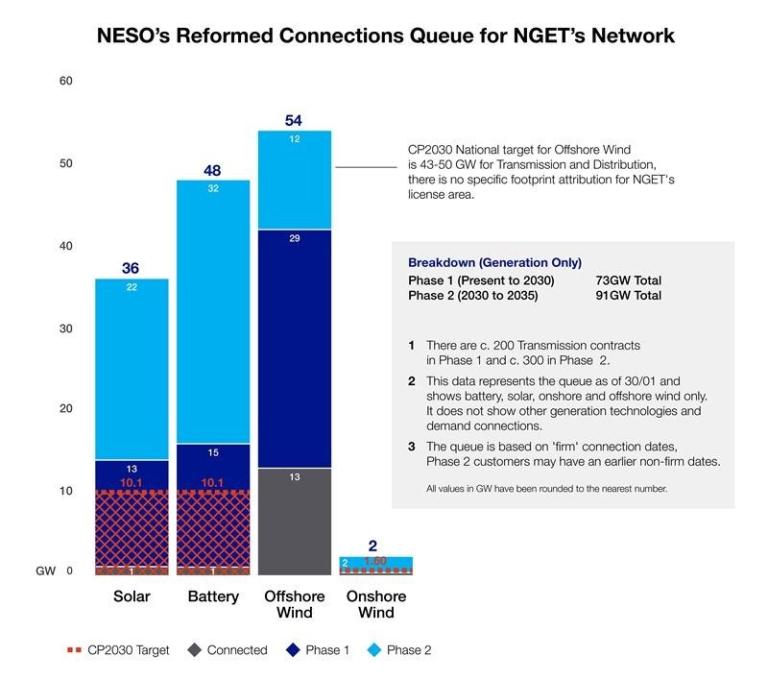
However, as the graph shows, we are still seeing significant oversubscription, particularly across battery and solar projects, with volumes exceeding what is needed for CP2030. The queue also includes ~70GW of directly-connected demand. We continue to work with NESO on ensuring a final consolidated view of the data.
This volume of projects matters for three reasons:
Firstly, because connecting these projects will require network resources, such as system access and supply chain capacity, which might otherwise be used for other projects.
Secondly, because we must design the network holistically, so we have to take into account projects post-2030 when designing the network pre-2030. We therefore expect implications for connections solutions for those in Phase 1.
And thirdly, because we must protect our existing and future customers from the costs of building more capacity than is needed, should this volume of projects reduce in the future.
We have raised the issue of oversubscription with NESO, other networks, Government and Ofgem, and we are working hard with all parties on potential practical technical, policy and process options to address these. For example, at a working session at the Department for Energy Security and Net Zero (DESNZ) last week with a number of developers, the topic of bay sharing was raised, so we have committed to bringing back some more context on how we do this today, and options in the context of oversubscription.
Planning assumptions (CPAs) and delays to the Reform timeline
As we highlighted in our last newsletter issued in November, at NGET we were preparing extensively through the summer and autumn of 2025, holding workshops with our Distribution Network Operator (DNO) colleagues, and running regional engineering studies.
We highlighted the importance of the Construction Planning Assumptions (CPAs), which NESO provide to the Transmission Owners (TOs) to inform our engineering studies. These set out forecast volumes of generation and demand by region, and are used to identify which reinforcements are needed before connecting each customer.
As noted through our engineering work in the autumn, we surfaced that the CPAs were driving outcomes that would see customers’ connections dates go backwards and lead to higher costs. NESO has taken these insights into account and are reworking and reissuing the CPAs. This is a positive step forwards; however, it does mean that we will now need to re-run the engineering we carried out in 2025.
We understand that this will be frustrating news for customers and adds a further period of uncertainty regarding your projects, and we are committed to ensuring that quality offers are issued as soon as possible, providing you with the details and assurance you need to continue to progress your projects.
Advancement: why it hasn’t been offered and what might change
We know customers have questions about this topic and recognise that many of you are disappointed with the lack of project Advancement offered.
We required the reformed queue and the background study data (CPAs) from NESO in order to do the Advancement checks. With publication of the reformed queue being pushed back, and the CPAs not yet been finalised, the scope of what we could offer was significantly reduced.
While Advancement was a one-time process, we will continue to explore opportunities to accelerate projects as part of our assessments, once we receive the updated CPAs and can carry out our engineering studies.
What next?
We have received some draft CPAs from NESO, and expect to start receiving the final versions from late February. This will then kick start the next phase of Connections Reform for our teams here at NGET, as we use the CPAs to run the engineering studies needed to inform customers’ updated connections offers.
How we will engage with you during the next stage
Protected Offers are being issued to NESO, and will be shared with customers in the coming weeks.
Customers have told us that having early conversations was helpful, and we are now working on our approach for engagement on the next phase of projects. We appreciate the input that many of you have shared with us in terms of what’s most important for you, please do continue to share. We will use our next newsletter to bring that together into an overview of the approach we intend to take and timelines we are working to.
As always, thank you for your engagement and collaboration, we look forward to working closely with you all throughout this next phase of Connections Reform and beyond.
Warm regards,
John Twomey
Director of Customer & Network Development
For the latest information on Connections Reform, visit NESO’s dedicated page: www.neso.energy/industry-information/connections-reform